OzAmmonia
OzAmmonia is a spin out company from the University of New South Wales (UNSW Sydney) developing an innovative electrolyser technology capable of producing renewable ammonia from waste NOx emissions.
Their system offers a low carbon alternative to the conventional NOx abatement technologies, which require high temperature and reagents, and is capital-intensive.
Background and purpose
Industries such as mining, transportation, and shipping generate nitrous oxide (NOx) as a harmful waste product. To support Australia’s Net Zero transition, OzAmmonia is developing an electrolyser that converts this NOx waste into renewable ammonia by providing both an emissions reduction pathway and a sustainable chemical feedstock.
By partnering with the AMRF through our Collaborative Research Program, OzAmmonia sought to accelerate the development of its next generation cathode and electrode technologies. The project focuses on validating manufacturing approaches, assessing candidate geometries, and enabling optimised performance through advanced additive manufacturing.
The method
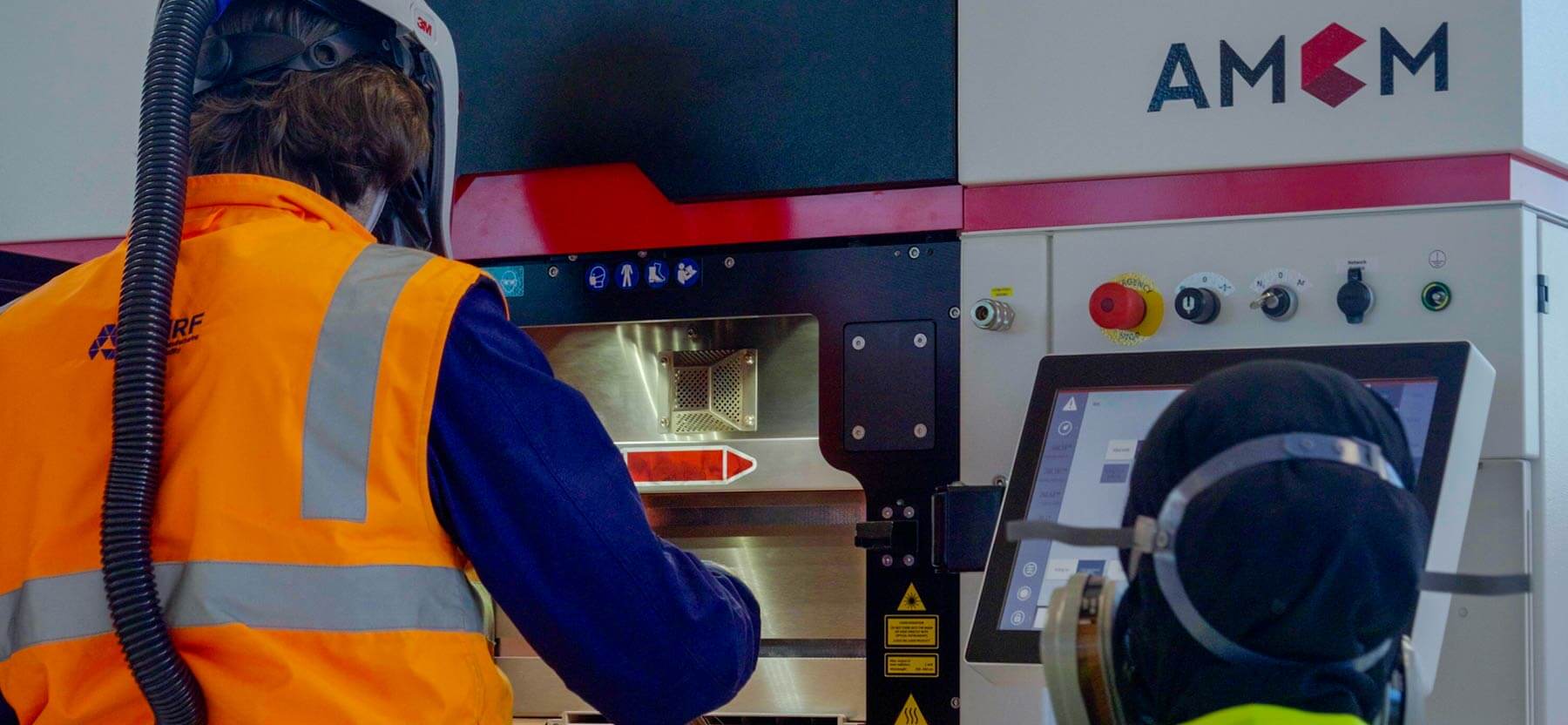
Metal additive manufacturing using the AMCM M290-1 FLX, plus materials and design support, allowed OzAmmonia to test four lattice geometries in one project cycle.
"OzAmmonia is very grateful for the support of AMRF in developing unique electrode structures for our patented electrolyser for the conversion of waste NOx to ammonia.” – A/Prof Rahman Daiyan, Co-founder & CEO, OzAmmonia
AMRF helped turn OzAmmonia’s early ideas into real, test ready components. Together, we defined what the electrodes needed to achieve, translated those needs into practical designs, and manufactured high quality prototypes using advanced metal 3D printing. These prototypes were refined for maximum performance with the right surface area, porosity and structure while still being efficient to produce.
At the same time, AMRF explored four different 3D printed lattice patterns to see which one performed best inside OzAmmonia’s electrolyser. These tiny 50 × 50 × 1 mm samples were designed to push the boundaries of what metal additive manufacturing can achieve.
“Advanced 3D printing techniques provide a pathway for maximising reactant access to our catalyst, improving overall activity and reducing capital cost - a requirement for this technology to be scaled up. The team is currently investigating and optimising a range of improved electrode designs with the support of AMRF." - Dr Josh Leverett, Co-founder & CPO, OzAmmonia
Each design offers different advantages — more surface area, better airflow, or improved efficiency. By comparing them side by side, the team is helping OzAmmonia identify the most promising structure to carry forward into future development.
"Working with OzAmmonia and UNSW is convincing proof of the value and capability of Australian innovators. At the AMRF we are proud to offer the types of capabilities that unlock growth of businesses with ground-breaking products such as OzAmmonia's novel ammonia electrolyser. Now proven on production-relevant equipment, the business is poised to scale up the technology here in Australia." - Ben Kitcher, Executive Director, AMRF
The result
This project delivered meaningful, tangible results for OzAmmonia and their pathway toward clean, renewable ammonia production.
Through the AMRF's Collaborative Research Program, OzAmmonia were able to:
- Keep production in Australia, reducing lead times and costs
- Accelerate design iteration with four lattice geometries tested in a single project cycle
- Move closer to commercial scale and progress from TRL 4 toward TRL 5/6
- Access advanced equipment and expertise including the AMCM M290-1 FLX
Marley Flow Control
Marley Flow Control is the first business to complete a project with the Advanced Manufacturing Readiness Facility (AMRF).
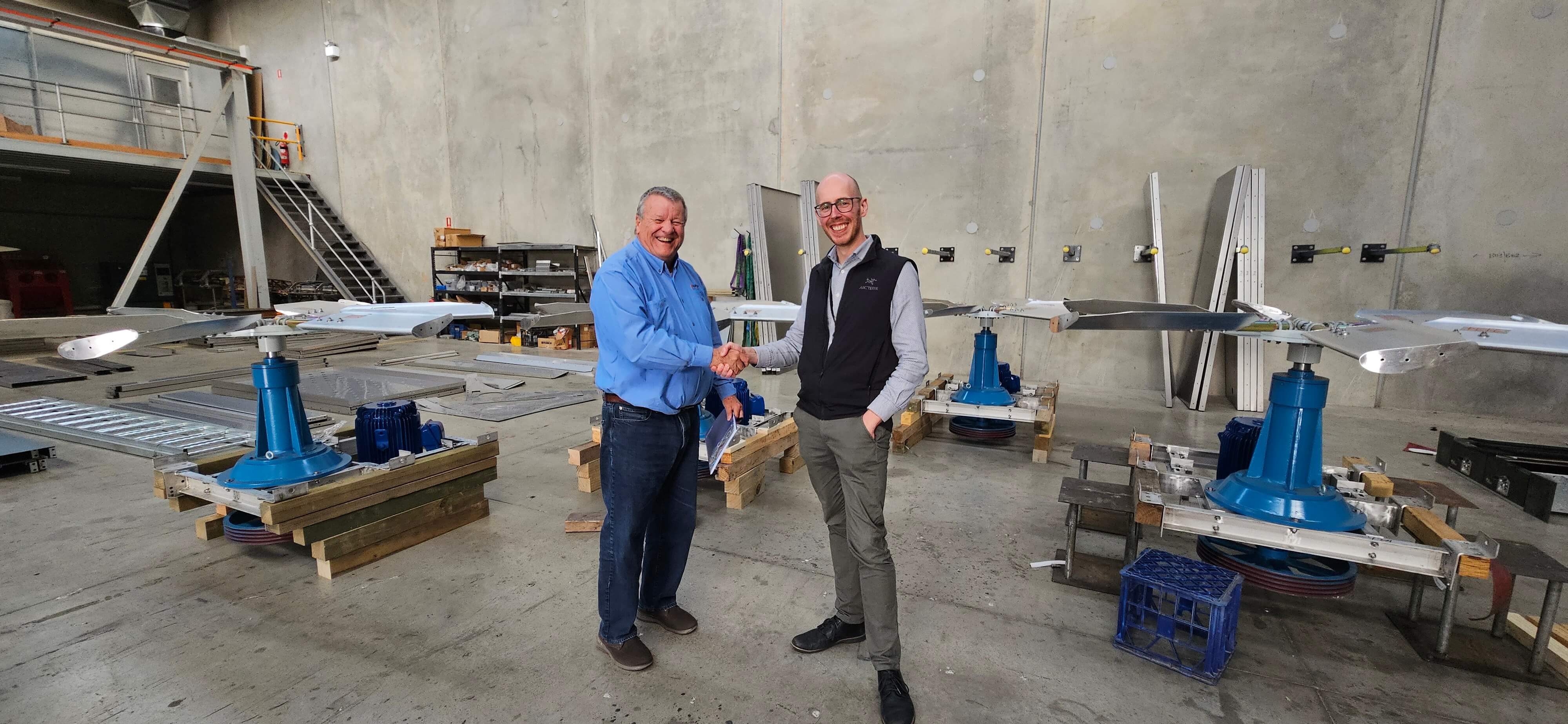
The Western Sydney-based engineering company specialise in manufacturing and maintaining cooling towers, used in large scale thermal control systems across a range of industrial settings.
A key component of these cooling towers are novel composite fan blades.
Background and purpose
With customer demand growing, Marley Flow hope to achieve significant uplift in throughput of their blades.
A time-study project was conducted to set baseline conditions and investigate what modifications could enable Marley Flow to achieve their future production goals.
The method
The manufacturing process was filmed using time lapsed video recording, which recorded the end-to-end process to produce fan blades.
This footage was then used to measure the time and resource required for each step in the manufacturing process. The data was further analysed to identify opportunities to enhance efficiencies the impact these had on production. Raw data was tabulated from the video footage to determine time spent in each part of the workflow.
"This time study revealed a staggering potential sixfold increase in throughput, thanks to a combination of easily achievable process improvements and the innovative capabilities we proudly offer in-house at the AMRF.
This is a groundbreaking opportunity that would revolutionise the production of composite blades". – Nathan Howell Lead Engineer, Composites Manufacturing, AMRF
The result
Five key recommendations and six process improvements were suggested through the time study that could generate six times the current productivity. Marley Flow reported an immediate uplift in productivity of 15-20%, with potential for further increases as recommendations are integrated over time. Marley Flow and the AMRF are now working on some follow-on projects to continue to enhance their market competitiveness.

Background and purpose
ChezLeon approached the Advanced Manufacturing Readiness Facility (AMRF) to help resolve quality and consistency issues in their garment prototyping process. Their existing method produced varied results and was difficult to scale. Preceding a clinical study involving Head and Neck Cancer patients, ChezLeon needed a more stable, repeatable approach to manufacturing.
The method
The AMRF engineering team reviewed ChezLeon’s forming process and identified key variables affecting prototype quality, including temperature distribution and pressure control.
- Reconfigured the thermal press cycle
- Modified forming parameters to support consistent mould alignment
- Enabled even material flow and repeatable results across batches
- Documented the refined process to support future semi-automation
“Small businesses in particular need facilities like the AMRF — government-backed centres that help develop semi- to fully-automated processes and equipment so they can stay competitive. Automation, AI, and robotics are key to advancing manufacturing in Australia. We need to embrace these technologies, and AMRF helps us do exactly that.” - Cheryl Pollock, CEO and Founder, ChezLeon Pty Ltd.
The result
ChezLeon was able to produce reliable, high-quality prototypes suitable for clinical trials. The improved process reduced cycle time by around 80 percent, increased production consistency, and improved quality outcomes. This set the groundwork for transitioning from manual to semiautomated manufacturing.
The project also demonstrated AMRF’s broader capabilities in:
- Early-stage automation planning and implementation
- Process development for medtech
- Applied engineering support for start-ups and SMEs
Open projects
Powerhouse Museum & Caon Design Office
The AMRF has partnered with Powerhouse Museum and Caon Design Office to deliver a landmark time capsule project for the opening of the new Powerhouse Parramatta in late 2026.
Designed by acclaimed industrial designer David Caon, the project brings together world‑class design and advanced manufacturing, with the AMRF leading the engineering development, manufacturing preparation and full production of the capsule.
Leveraging capabilities across additive manufacturing, precision machining and assembly, the AMRF will translate the design into a fully engineered, environmentally sealed artefact built to preserve contemporary stories of science and technology for future generations.
This collaboration demonstrates how design, culture and advanced manufacturing can come together to create enduring, real‑world outcomes.
Space Machines Company
The AMRF has partnered with Space Machines Company on a CRC‑P-funded project to accelerate the design and manufacture of the Optimus Viper spacecraft, bringing together industry, research and government to deliver real, onshore impact.
Led by Space Machines Company in collaboration with UTS and Fordyno, the two‑year project will integrate cutting‑edge generative AI design with the AMRF’s advanced manufacturing capabilities - including composites, additive manufacturing, precision machining, and metrology - to rapidly move from concept to flight‑ready hardware.
By combining intelligent design with scalable, production‑ready processes, the project aims to reduce development time, unlock new spacecraft architectures and strengthen Australia’s sovereign manufacturing capability for the space sector.
This project also demonstrates the AMRF’s collaborative pathways engagement model in action, leveraging Commonwealth co-funding to give SMEs much-needed access to advanced manufacturing capability, while aligning state and federal investment to drive productivity and onshore industry growth.